

As the first hotel in Mecklenburg-Vorpommern with a climate-positive balance sheet, our aim is to take responsibility for the environment, reduce environmentally harmful emissions, increase the well-being of our guests and provide impetus beyond the borders of our region.
We want to show that tourism and ecology can go hand in hand and that sustainability can also be achieved in the upscale hotel industry.


In October 2005, we were the first hotel in the Mecklenburg-Schwerin region to be certified by the Viabono umbrella brand. It is a joint initiative of the Federal Government in co-operation with tourism, environmental and consumer associations. The VIABONO Trägerverein e.V. now includes 18 leading organisations (including the German Hotel and Restaurant Association DEHOGA, ADAC, NABU, German Tourism Association, ADFC).
Based on a comprehensive catalogue of criteria, all Viabono members undergo a strict admission check. This quality control is carried out in several stages, from the submission of supporting documents and random checks on site to customer-supported quality management.
Since 2010, we have been one of the first hotels in Germany to offer our guests climate-neutral accommodation. The hotel is a co-founder of the "Klima-Hotels Deutschland" initiative, whose members fulfil the requirements for certified and ecological hotel management with the help of the Viabono environmental brand.
We are committed to continuously reducing CO₂ emissions and offsetting unavoidable residual emissions by investing in recognised climate projects.
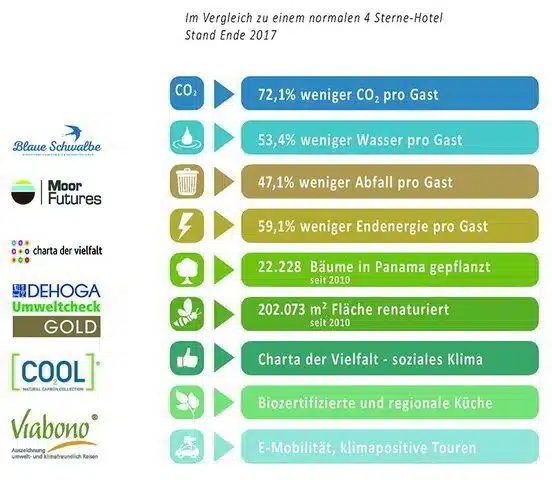
In November 2017, we became the first hotel in northern Germany to be certified with a positive carbon footprint. Climate-positive means that we now bind more CO₂ through climate protection projects than we actually produce in our hotel operations.


We endeavour to take environmental concerns and impacts into account in all our decisions.
The following examples should be mentioned;
The kitchen makes a lot of things itself, e.g. our muesli, spreads and dips. As a matter of principle, we use many foods of regional and organic origin:
The organic certification is carried out by the Ökokontrollstelle e.V.
Viabono certifies the CO₂ footprint, which is recalculated for us annually based on the CO₂ emissions generated in hotel operations. All CO₂-relevant processes in the areas of energy, buildings and technology, food, cleaning, print, delivery routes, employee journeys, etc. are recorded.
In 2016, only 18.57 kg of CO₂ were produced per overnight stay. The average emission load of a hotel in the 4-star category is around 50-60 kg of CO₂ per overnight stay and is therefore much higher. In concrete terms, this means that the Speicherhotel produces 72% less CO₂ per guest, 35% less waste is produced and the consumption of final energy per guest is also 55% below the industry average.
We provide our guests with two charging stations for electric cars as well as e-bikes and city bikes for exploring the city and surrounding area (for a fee).
When building our car parks, we also took care to minimise surface sealing.
In 2012, we offset a portion of our greenhouse gas emissions for the first time through a rewetting project of drained moorland in Mecklenburg-Western Pomerania. By rewetting the former moorland, the decomposition of peat into carbon dioxide, one of the most significant greenhouse gases, is halted.
This so-called Moor Futures project was developed by the Ministry of Agriculture in close cooperation with Greifswald University of Applied Sciences and NABU e.V.. Offsetting on site makes our work for climate protection even more transparent and, above all, tangible for our guests.
264 hectares of forest (approx. 227 football pitches) were reforested by Klima-Hotels together with CO₂OL in Panama from 2010 to 2022. Young trees planted on previously extensively used cattle pastures and fallow land are growing into a co-operative mixed forest.
The high proportion of native tree species and the reforestation in mixed cultures create an ecosystem that offers animals and plants new habitats and makes original habitats usable again.
The reforestation has restored the following animal species, for example:
Pakas, mantled howler monkeys, coyotes, agoutis, armadillos, golden tree climbers, southern possums, jaguarundi, ocelots, white-trunked coatis, tungara frogs and many more.
The project helped to improve working and living conditions in rural areas of Panama. Employees receive a salary above the statutory minimum wage, including statutory health and pension insurance. The basic and advanced training ensures a higher level of education and opens up access to new jobs.
In this way, the climate hotels offset the unavoidable CO₂ emissions generated in the hotels and determined by the CO₂ footprint.




 English (UK)
  Deutsch